


Hot rotary forging for near-net-shape toothed components.
Controlled hot deformation for full die filling and optimised grain flow.
High structural integrity and repeatable production for demanding gear applications.
The Challenge
Precision in sound starts with precision in forming.
Saxophone bell production relied heavily on manual spinning.
Results depended on operator skill. Repeatability was limited.
Variations in geometry affected acoustic consistency and increased material waste.
The objective was clear:
Stabilise production without compromising sound quality.
The DENN Solution
Using our NTR CNC rotary metal forming lathe, DENN developed a fully controlled and repeatable spinning process for saxophone bell manufacturing.
Multiple operations are integrated into a single programmed cycle:
- Spin forming of the bell geometry
- Diameter trimming
- Edge bending
- Bead height control
- Optional reinforcing ring integration
- Final beading operation
All performed on one machine.
Stable. Repeatable. Production-ready.
The Result
Controlled material flow ensures consistent wall thickness and geometry across batches.
Manufacturers achieved:
- Higher repeatability
- Reduced material waste
- Lower defect rates
- Shorter cycle times
- Improved surface finish
- Stable acoustic performance
Automation did not replace craftsmanship.
It stabilised it.ior base for final finishing operations while significantly reducing downstream machining requirements.
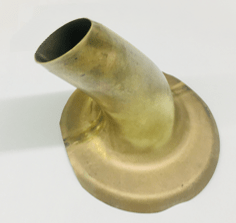
Perform
Welded and extructured brass perform
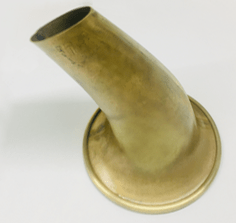
Final part
Saxophone bell with reinforced bead
Why It Matters
In musical instruments, microns define performance.
Behind the machine configuration, tooling strategy and process parameters, there is a dedicated engineering team working closely with the customer.
At DENN, we control material flow.
The result is stable output — even when sound is the final measure.