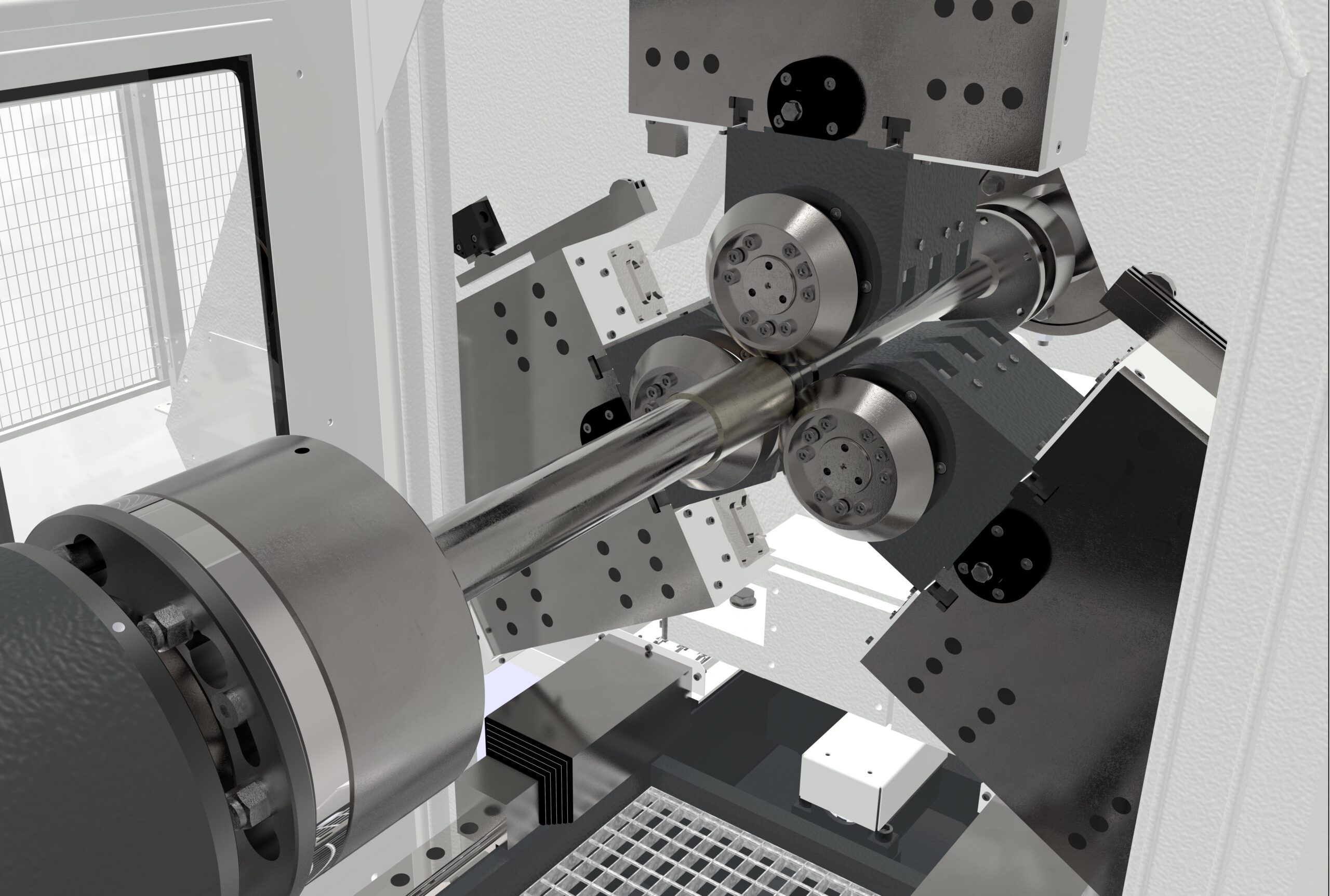


Flow forming for optimised thickness distribution and high-quality cookware production
Controlled flow forming of aluminium and stainless-steel cookware.
Optimised material distribution, high surface quality and flexible production in a single machine.
The Challenge
Manufacturers of cookware components (including pots, pans and cylindrical containers) must balance product performance, material efficiency and production flexibility.
Traditional manufacturing routes, typically based on stamping and deep drawing processes, impose several limitations:
- Uniform thickness across the entire component
- High material consumption and trimming waste
- Limited flexibility for different geometries and sizes
- Multiple forming and secondary operations
- Additional finishing requirements to achieve surface quality
At the same time, cookware products require:
- High surface quality (interior and exterior)
- Controlled thickness distribution
- Structural strength at the base
- Lightweight sidewalls for usability
- Flexibility across materials such as aluminium and stainless steel
The objective was clear:
improve material efficiency and product performance while simplifying the production process.
The DENN Solution
DENN developed a controlled flow forming process using RL CNC spinning lathes, combined with auxiliary forming operations.
The process starts from a flat disc or preformed blank, positioned on the mandrel and clamped by the tailstock.
During flow forming:
- The rollers apply controlled pressure while moving along the mandrel
- Material flows plastically, adapting to the geometry of the mould
- Wall thickness is progressively reduced and redistributed
- Multiple passes can be applied depending on geometry, material and reduction requirements
For cylindrical stainless steel components, thickness reduction can reach up to 80% from the preform, while maintaining high dimensional control.
This enables a key advantage:
- Thick bottom for structural resistance
- Thinner sidewalls for weight reduction
In addition to flow forming, the process integrates auxiliary operations within the same production environment:
- Beading and flanging for structural and functional features
- Edge forming and trimming
- Marking and surface finishing preparation
- Ring joining (seaming) operations when required
Depending on part geometry, conventional spinning operations can also be combined with flow forming to optimise the process.
All operations are performed on versatile CNC machines capable of handling different diameters, thicknesses and materials.
The Result
The implementation of flow forming technology delivers clear industrial benefits:
- Optimised thickness distribution across the component
- Significant reduction in raw material consumption
- Lighter final products with improved usability
- High surface quality, reducing polishing and finishing operations
- Reduced production times
- High flexibility for multiple product geometries and sizes
- Single-machine processing, minimising handling operations
- Low tooling cost compared to traditional stamping processes
- Reduced noise levels compared to press-based manufacturing
Manufacturers achieve a more efficient, flexible and scalable production model for cookware components.
Why It Matters
In cookware manufacturing, performance is defined not only by shape, but by how material is distributed within the part.
Flow forming enables manufacturers to engineer thickness, weight and strength simultaneously, achieving better products with less material and fewer process steps.
By combining flow forming with auxiliary operations in a single platform, production becomes more flexible, efficient and controllable.
At DENN, we do not simply shape cookware.
We control material flow to optimise performance, efficiency and industrial scalability.